
Choosing a Rifle Cartridge for Large and Dangerous Game
A Ballistics-Based Approach to Ethical Kills
Selecting a cartridge for large or dangerous game isn't about picking the biggest, loudest round on the shelf. It's an exercise in matching bullet weight, caliber, velocity, and construction to the size, toughness, and anatomy of the animal you intend to hunt — with the explicit goal of achieving an accurate, humane kill. Hunters, professional guides, and game departments around the world have developed rules of thumb and minimum-energy standards over more than a century of field experience. Understanding the physics behind those standards, and how they translate into real cartridge choices, is essential for anyone planning a hunt for elk, moose, bear, or African plains and dangerous game.
Why Energy Alone Doesn't Tell the Whole Story
The starting point for most cartridge-selection discussions is kinetic energy, expressed in foot-pounds (ft-lb) or joules. Energy is calculated from the classic formula:
E = ½ × m × v²
where m is the bullet's mass and v is its velocity. Because velocity is squared, small increases in speed produce outsized increases in energy — which is why magnum cartridges built around higher velocities generate so much more muzzle energy than standard rounds firing similar bullet weights.
However, energy figures alone are a blunt tool. Two cartridges can produce identical muzzle energy while behaving completely differently on game: a lightweight bullet moving very fast carries much of its energy in velocity, which sheds quickly as the bullet slows downrange and can also cause the bullet to fragment violently on impact rather than penetrating. A heavier, slower bullet carries more of its energy in mass, retains velocity better at range, and typically penetrates deeper. This is why experienced hunters and ballisticians also look at momentum, sectional density, and bullet construction alongside raw energy.
Momentum (p = m × v) scales linearly with velocity rather than by the square, so it rewards mass more than energy does. Momentum correlates closely with penetration — a critical factor when the goal is reaching the vitals of a large-bodied or thick-skinned animal, potentially after passing through heavy muscle, shoulder bone, or a raised foreleg.
Sectional density (SD), calculated as a bullet's weight in pounds divided by the square of its diameter in inches, describes how "slender" a bullet is relative to its frontal area. Higher sectional density generally means deeper penetration, because the bullet presents less resistance per unit of weight as it drives through tissue.
Bullet construction — whether a bullet is a rapidly expanding thin-jacketed softpoint, a bonded controlled-expansion design, or a solid/monolithic non-expanding bullet — determines how the animal's tissue absorbs the available energy. A premium bonded or monolithic bullet retains 90–100% of its weight and drives deep with a controlled wound channel, while a cheap cup-and-core bullet may fragment and fail to reach vitals on a large animal even if it carries more raw energy at the muzzle.
Industry and Regulatory Minimum Energy Standards
Because energy alone is an imperfect predictor of killing power, hunting organizations, professional hunting associations, and some national game authorities have published minimum muzzle-energy thresholds tied to animal size and danger category. These standards are widely treated as industry practice, particularly in Africa, where professional hunters are legally and professionally responsible for ensuring clients use adequate calibers.
Commonly cited benchmarks include:
Plains game (impala, springbok, similar): roughly 1,000–1,500 ft-lb of energy at point of impact is often considered a practical minimum, though many hunters carry considerably more margin.
Medium-large plains game (kudu, wildebeest, zebra, elk, moose): approximately 1,500–2,500 ft-lb at the point of impact, with cartridges such as the .270 Winchester, .30-06 Springfield, and 7mm Remington Magnum commonly meeting this threshold well within normal hunting ranges.
Large and dangerous game (Cape buffalo, elephant, rhino, hippo, brown/grizzly bear): many outfitters and several African countries set a legal minimum caliber, commonly .375 (9.5mm) or larger, generating on the order of 4,000–5,000+ ft-lb of muzzle energy, paired with a requirement for deep-penetrating solid or bonded bullets. Namibia, Zimbabwe, and several other jurisdictions codify minimum calibers for buffalo and elephant hunting into law.
Elephant specifically: professional hunters frequently recommend cartridges in the .458 Winchester Magnum to .470 Nitro Express class, delivering 5,000 ft-lb or more, using solids capable of penetrating dense skull and shoulder bone to reach the brain or vitals.
These figures are guidelines rather than hard physical laws — shot placement remains the single most important variable in any ethical kill — but they represent decades of accumulated field data on what it typically takes to reliably and quickly incapacitate animals of a given size, especially when a shot is imperfectly placed or must break heavy bone.
Matching Cartridge to Animal Weight and Anatomy
A practical way to think about cartridge selection is to consider three variables simultaneously: animal body mass, vital area depth, and danger level.
Body mass determines how much tissue and bone a bullet may need to penetrate to reach the vitals, especially on a quartering or less-than-ideal angle. A 120-pound whitetail deer has vitals that sit close to the surface and are easily reached even by moderate cartridges like the .243 Winchester. A 1,500-pound Cape buffalo, by contrast, may require a bullet to punch through a heavily muscled shoulder and thick rib bone before ever reaching the heart or lungs.
Vital area depth varies by species independent of body weight. Bear, for example, carry substantial fat and dense muscle that can close a wound channel and slow blood trailing, which is one reason experienced bear hunters often step up in caliber beyond what raw body weight alone might suggest.
Danger level changes the calculus entirely. Dangerous game — buffalo, elephant, lion, and brown bear among them — can charge when wounded, so the standard shifts from "sufficient energy to eventually cause a fatal wound" to "sufficient energy and penetration to reliably stop the animal quickly," which is why minimum-caliber laws exist specifically for these species and not for plains game.
A widely used rule of thumb among hunting guides ties recommended muzzle energy to game category:
Small/medium deer — Whitetail, pronghorn Body weight: 100–200 lb · Recommended energy at impact: 800–1,200 ft-lb
Large deer/mixed game — Mule deer, black bear Body weight: 200–400 lb · Recommended energy at impact: 1,200–1,800 ft-lb
Elk-class — Elk, moose, red stag Body weight: 500–1,200 lb · Recommended energy at impact: 1,800–2,800 ft-lb
Large dangerous game — Grizzly/brown bear, kudu-class African game Body weight: 500–1,500 lb · Recommended energy at impact: 2,500–4,000 ft-lb
Heavy dangerous game — Cape buffalo, hippo Body weight: 1,000–2,000 lb · Recommended energy at impact: 4,000–5,500+ ft-lb
Thick-skinned giants — Elephant, rhino Body weight: 5,000–14,000 lb · Recommended energy at impact: 5,000+ ft-lb with solids, penetration prioritized over energy
These figures should be read as general planning references, not as guarantees — an ethical kill always depends on shot placement above all else, and a well-placed shot from a moderate cartridge will outperform a poorly placed shot from a magnum every time.
Accounting for Downrange Ballistics
Muzzle energy is only the starting point. Every bullet loses velocity — and therefore energy — as it travels downrange due to aerodynamic drag, so a cartridge that meets the energy threshold at the muzzle may fall short at extended range. This is where the ballistic coefficient (BC) of the bullet matters: a higher BC bullet sheds velocity more slowly and retains more energy at distance.
For example, a .30-06 Springfield firing a 180-grain bullet at roughly 2,700 fps muzzle velocity generates around 2,900 ft-lb at the muzzle. By 300 yards, that same bullet may retain only 1,700–1,900 ft-lb, depending on its ballistic coefficient. A hunter planning shots at longer range needs to calculate — or consult published ballistic tables for — the retained energy at the actual anticipated shot distance, not just the muzzle figure, to confirm the cartridge still meets the ethical minimum at the moment of impact.
This is particularly important for open-country hunting of elk or plains game, where shots of 300 yards or more are common, and for mountain hunting where steep uphill or downhill angles further affect the trajectory. Serious hunters use a chronograph to verify actual velocity from their specific rifle and load, then run that data through a ballistic calculator to produce a trajectory and energy table out to their maximum anticipated range, rather than relying solely on published factory figures, which can vary meaningfully from one rifle's actual performance.
Putting It Together: A Practical Selection Process
Identify the target species and its typical body weight, and note whether it falls into a dangerous-game category with a legal minimum caliber in the hunting jurisdiction.
Determine the maximum realistic shot distance for the terrain and hunting style — open plains versus dense bush produce very different requirements.
Select a cartridge and bullet weight combination that meets or comfortably exceeds the recommended energy threshold for that species at the anticipated maximum range, not just at the muzzle.
Choose bullet construction appropriate to the game — controlled-expansion or bonded bullets for most plains and elk-class game; deep-penetrating solids or heavy monolithic bullets for buffalo, elephant, and other thick-skinned dangerous game.
Verify actual performance with a chronograph and ballistic calculator rather than trusting catalog numbers alone, and pattern the rifle at realistic hunting distances to confirm accuracy holds up with the chosen load.
Practice shot placement relentlessly, since no cartridge compensates for a poorly placed shot, and the entire energy-and-penetration framework above assumes the bullet reaches the vital organs.
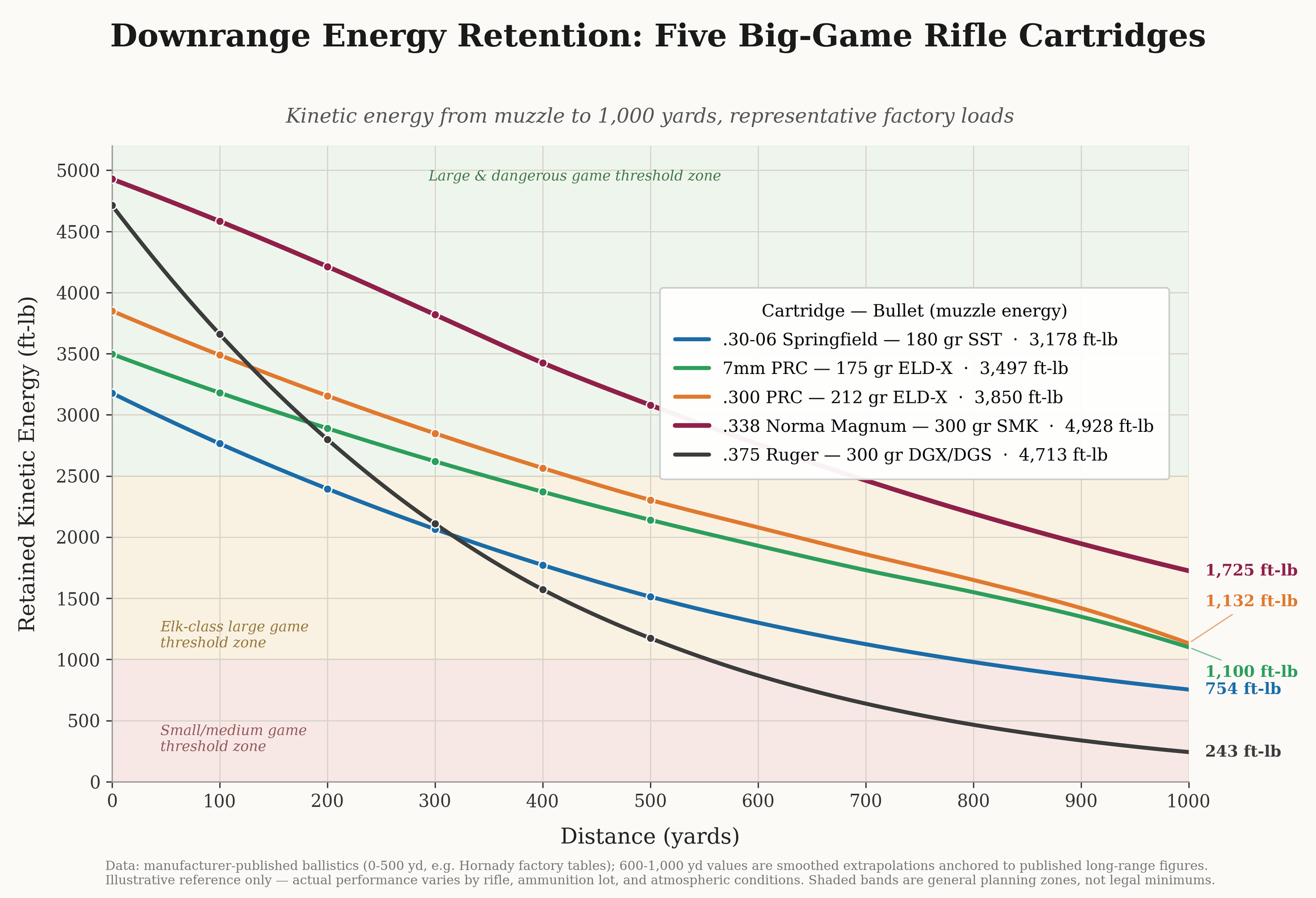
Energy Retention Chart
Conclusion
Choosing a cartridge for large or dangerous game is a matter of balancing bullet mass, caliber, velocity, downrange ballistics, and construction against the specific anatomy and danger level of the animal being hunted. Industry-accepted energy thresholds — ranging from roughly 1,000 ft-lb for small deer to well over 5,000 ft-lb for elephant — provide a useful planning framework, but they work best as one input among several. A hunter who understands the physics of momentum and sectional density, verifies real-world ballistic performance for their specific rifle and load, and prioritizes precise shot placement will be far better equipped for an ethical, humane harvest than one who selects a cartridge on reputation or raw muzzle energy alone.